Overbites and deep bites are two common kinds of misaligned teeth, also known as malocclusions. While a deep bite is a type of overbite, not all overbites are deep bites. Deep bites are a severe form of overbites.
At Ironwood Pediatric Dentistry, we have pediatric dentists who can detect an overbite or deep bite early in your child’s oral health development, as well as orthodontists who can treat these issues. In this blog post, we examine what overbites and deep bites are, how they differ from each other, and the options you have to correct them through child orthodontic treatment.
To learn more about overbite, deep bite, or any other kind of tooth misalignment problem that may be affecting your child’s oral health and smile, call us at (408) 422-4544 or contact us online to schedule an appointment with us.
How Are Overbite and Deep Bite Defined?
A deep bite and an overbite are similar but not identical. Here are the basic differences:
- An overbite refers to the horizontal overlap of the upper and lower front teeth when the jaws are closed. A normal overbite is two to four millimeters.
- An excessive overbite, where the upper teeth cover too much of the lower teeth, is known as a deep bite. In a deep bite, the overbite is more than four millimeters. A deep bite can be classified as mild, moderate, or severe. A deep bite of more than six millimeters is considered a severe deep bite and can cause problems with tooth appearance and function.
Distinguishing Deep Bite from Overbite
Overbites and deep bites have distinct differences in their origins, symptoms, and recommended treatment methods. Below, we address some of the most common factors that apply to these conditions, along with their specific considerations.
Causation
An overbite can be caused by genetic factors like irregular jaw development, early tooth loss, or bad oral hygiene. A common cause of an overbite is when the lower jaw is small.
A deep bite can also arise from genetic causes or childhood habits, such as thumb-sucking or prolonged pacifier use.
Severity of the Overlap Condition
Some overbite is normal. What makes an overbite a deep bite is when the overbite goes too far, with the upper front teeth covering most or all of the lower front teeth when your child’s mouth is closed.
Symptoms
Children with a minor overbite condition may experience few symptoms, but the appearance of their front teeth can cause them to become awkwardly self-conscious when eating, talking, or smiling.
Individuals with a deep overbite will often experience symptoms including tooth sensitivity, chronic jaw pain, headaches, and difficulty chewing or biting. Sometimes, dry mouth and breathing problems, such as excessive oral breathing, can also occur.
Effect on the Lower Teeth
An overbite can cause uneven pressure while biting or chewing. This can cause your child to experience discomfort when biting or chewing.
Compared to an overbite, a deep bite can lead to the lower teeth undergoing excessive wear on tooth enamel because they are constantly coming into contact with the upper teeth or gums. This can contribute to additional oral health problems, such as tooth sensitivity, tooth decay, and possible gum disease, caused by increased pressure.
Jaw Alignment Problems
An overbite can cause discomfort in the jaw. However, children with a deep bite often experience significant jaw misalignment.
This can cause temporomandibular joint disorders (TMJ). They may experience jaw pain, hear clicking sounds when moving their jaws, and struggle to open or close their mouths comfortably.
Appearance and Smile
A visible overbite can cause a child’s upper lip to protrude more than normal, although this does not usually result in significant appearance issues.
However, a deep bite can create noticeable changes to your child’s facial appearance because the upper teeth overlap the lower teeth so much that the lower teeth may not be visible when smiling.
Orthodontic Overbite Treatment and Deep Bite Treatment Options
Correction of an overbite or a deep bite depends upon the patient’s age, the type of condition, and its underlying cause. Your child’s dentist can diagnose the condition and assess its severity, then recommend working with an orthodontist to develop a treatment plan that may include braces, clear aligners, or surgery.
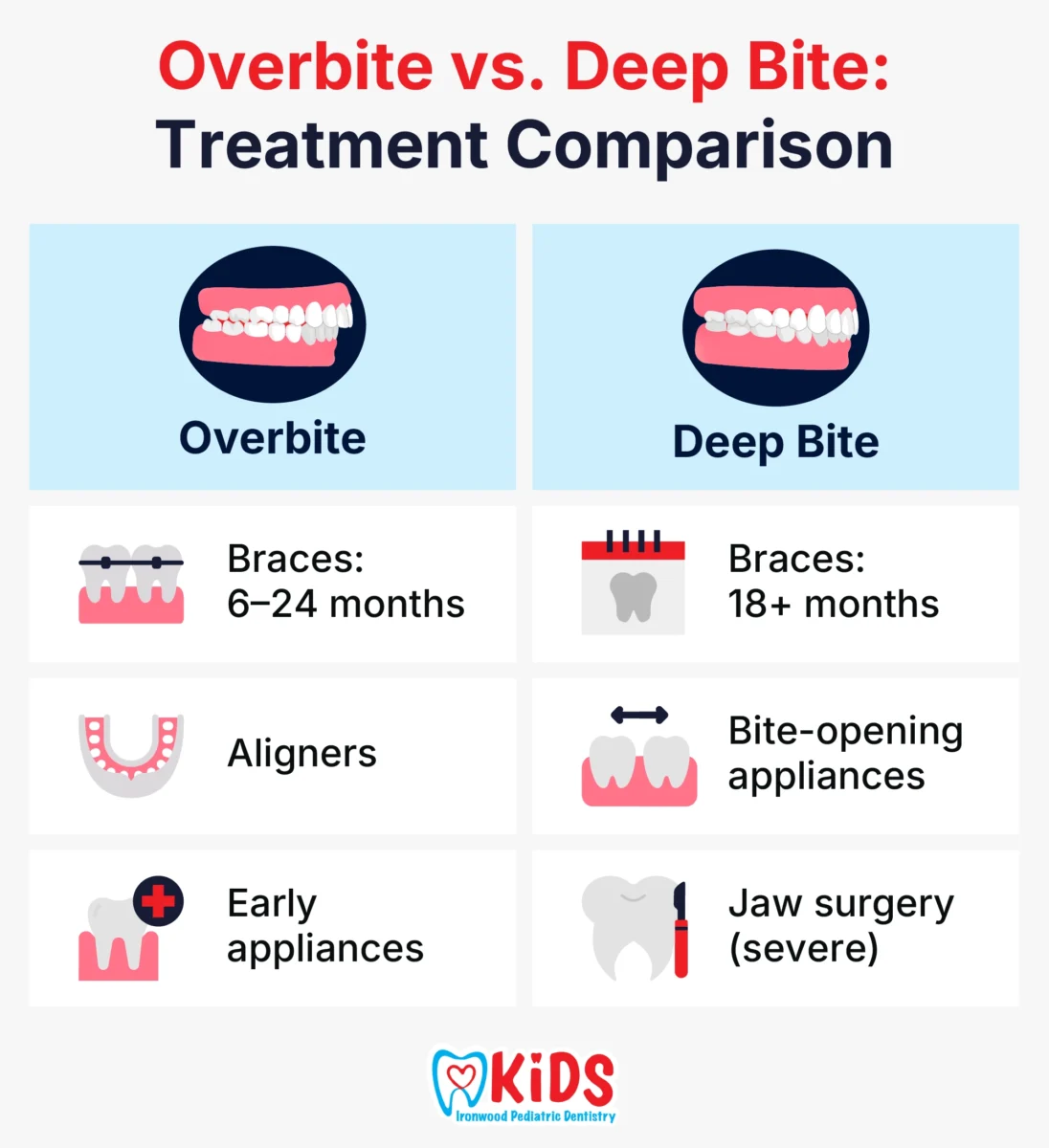
Orthodontics is effective in treating overbites and deep bites. The best age range to treat an overbite or deep bite is between five and nine years of age, although it can be treated into adolescence.
Overbite treatment typically takes between six months and two years to complete.
Children with a deep bite condition often require more extensive treatment due to the complex issues involved in realigning their teeth. The duration of orthodontic treatment for a deep bite can range from 18 months to a few years, depending on the severity of the bite.
Braces and Appliances
Braces are a common treatment for a deep bite.
Braces can be used in combination with dental appliances, such as a retainer, or in some cases, appliances can be used as an alternative to braces.
These appliances help position your child’s upper and lower teeth in a desirable position until the bite can be permanently corrected with the help of braces or other treatments. They are made of wires and plastic material, can be fixed or removable, and can reposition the jaws without having much contact with the teeth.
Invisalign
Invisalign is a set of clear, removable plastic trays. They need to be worn at least 20-22 hours a day. Aligner treatment consists of multiple sets of trays, each set being worn for about two weeks.
The trays create a continuous and gentle force on the teeth to move them to a desired position, with each new set building on the progress from the set before it.
Jaw Surgery
In severe overbite cases, oral surgery may be needed to correct a deep bite or restore bite alignment. This corrective jaw surgery involves cutting through the jawbone to realign it. In some cases, surgery may require the removal of bone tissue from one side of the jaw to make room for the jaw to come forward.
Surgery often requires the placement of metal screws or plates in the jawbones so that they can be moved into place more easily. After surgery, a mouthguard appliance is typically required for several weeks while your child’s mouth heals.
Does Your Child Have an Overbite or Deep Bite Problem?
It is essential for your child to receive regular dental care, including routine checkups, to identify potential malocclusion issues, such as overbites or deep bites. Your dentist will be able to recognize these conditions early on, allowing a treatment plan to be initiated promptly. The sooner overbite correction begins, the easier it will usually be to reposition crooked teeth or to guide jaw growth, and the less time it may take to get the desired results.
Prompt recognition and management of overbite or deep bite can also avoid more severe issues that can develop if these conditions are left untreated.
If you believe your child may have an overbite, deep bite, or any other oral health issue, please call Ironwood Pediatric Dentistry at (480) 422-4544 to schedule an appointment.