Your child’s airway can be obstructed by oral health issues that cause the tongue, teeth, or jaw to partially block it, resulting in uneven airflow into the lungs. This can lead to mouth breathing as a way to offset the problem.
Mouth breathing can lead to both oral health problems and breathing difficulties. Fortunately, orthodontic treatment options exist that can help correct malocclusions, such as underbites, overbites, and jaw misalignments, which may contribute to mouth breathing.
If your child has problems with mouth breathing, our experienced pediatric dentists and orthodontists at Ironwood Pediatric Dentistry can evaluate whether orthodontic treatment is necessary and provide effective solutions.
In this blog post, we discuss the possible relationship between crooked teeth and jaw misalignment and mouth breathing, the effects this can have on your child’s oral health, and how an orthodontic treatment plan can help in addressing mouth breathing.
To find out if orthodontics can help your child, schedule an appointment with us by calling (480) 422-4544.
What Are the Effects and Symptoms of Mouth Breathing?
People normally breathe through a combination of their nose and mouth. Some mouth breathing is natural. But when mouth breathing becomes more prevalent, it can contribute to several health problems that can have a serious effect on your child’s overall well being. We describe some of these problems below.
Dry Mouth and Bad Breath
Saliva plays a crucial role in your child’s immune defense. It has antibacterial properties, lubricates the mouth, and helps to prevent tooth decay. Dry mouth due to mouth breathing can reduce these protective effects of saliva.
The resulting dehydration of gum surfaces can contribute to the formation of plaque and to gum diseases, such as gingivitis, and eventually to periodontal disease.
Poor Facial Development in Children
In children, persistent mouth breathing can alter the development of the face and jaw. This can lead to:
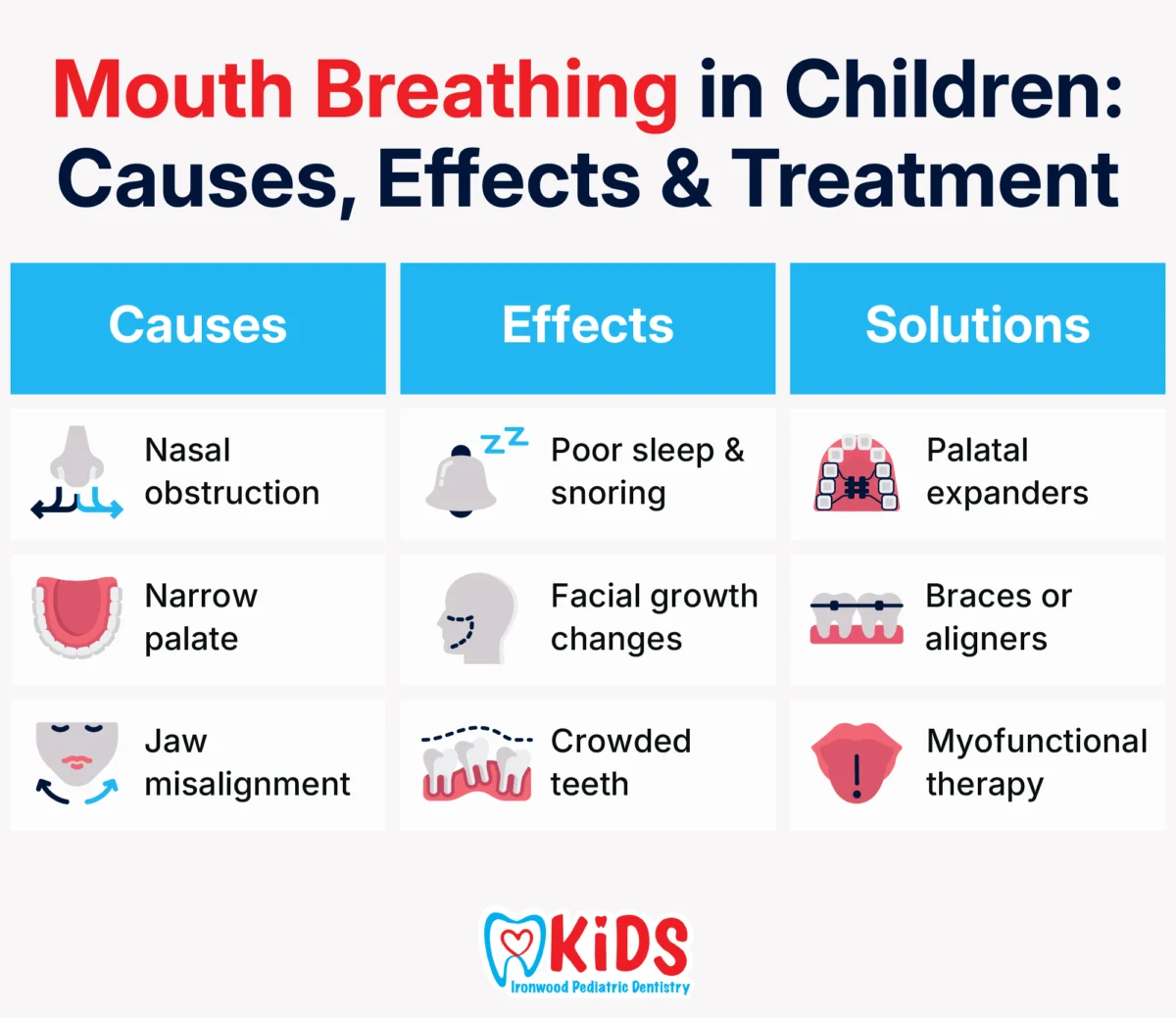
- A narrow upper jaw and high-arched palate. This can cause teeth overcrowding and make it harder to breathe through the nose.
- An elongated facial structure, also known as “long face syndrome.”
- A recessed chin and weak jawline. This affects bite alignment and leads to jaw pain.
Increased Risk of Orthodontic Problems
Some studies have linked mouth breathing to bite issues and misaligned teeth. This is because of the effect that mouth breathing has on where the tongue rests in your child’s mouth. This can lead to symptoms including:
- Narrow palates
- Crowded teeth
- Overbites, underbites, and crossbites
Sleep Disturbances and Fatigue
Mouth breathing can lead to poor sleep quality because of how it can interfere with oxygen flow. Many habitual mouth breathers experience:
- Snoring and restless sleep
- Obstructive sleep apnea (OSA), where breathing stops momentarily during sleep
- Daytime fatigue and difficulty concentrating
In children, sleep disordered breathing problems caused by mouth breathing can even contribute to behavioral issues, ADHD-like symptoms, and difficulty focusing in school.
Posture Issues and Jaw Pain
Constant mouth breathing can lead to postural imbalances. Because mouth breathers tend to keep their head tilted forward to open the airway, this can cause:
- Neck and shoulder tension
- Chronic headaches
- Jaw joint discomfort
What Causes Mouth Breathing?
Teeth or jaw misalignment and mouth breathing can contribute to one another.
For example, children with mouth breathing issues tend to have related problems with their lingual muscles. This can contribute to increased risk of open bite, crossbite, and overbite.
If your child has a severe malocclusion and jaw alignment problems, and breathes through his or her mouth all night long without changing positions, then the tongue can block off part of their airway and make the situation even worse.
Mouth breathing can result from several causes, including:
- Congestion of nasal passages
- Sinus infections
- Allergies
- Enlarged adenoids or enlarged tonsils
- A narrow palate (a high-arched roof of the mouth)
- Sleep apnea or airway obstructions
How Can Orthodontics Help Treat Mouth Breathing?
Given the connection between mouth breathing in children and teeth and jaw alignment problems, many orthodontists stress the importance of identifying mouth breathing issues in children starting as early as age three.
Orthodontics can be an effective treatment for mouth breathing by correcting oral structural problems. Depending on which of these structural issues is present in your child, orthodontic treatment methods can include any of the following in a personalized treatment plan.
Palatal Expanders (MARPE)
One of the most common causes of mouth breathing is a narrow upper jaw, which can restrict airflow through the nose. MARPE (Minimally Invasive Rapid Palatal Expansion) is an advanced orthodontic treatment that widens the upper jaw, creating more space in the nasal airway and making it easier to breathe through the nose naturally.
An orthodontist attaches the expander to your child’s teeth with bands or wires around each tooth. As your child’s jaw grows, it creates more space inside the mouth, allowing for improved breathing at night.
Braces or Invisalign
As we have shown above, mouth breathing can be linked to poor jaw positioning. Braces or Invisalign clear plastic aligners can help align your child’s bite, moving misaligned teeth and jaws are in their ideal position for better nasal breathing.
Myofunctional Therapy and Habit Correction
Some cases of mouth breathing are caused by poor oral habits or weak muscle function. Myofunctional therapy can strengthen the tongue, lips, and facial muscles to encourage nasal breathing.
When Should You See an Orthodontist for Mouth Breathing?
Mouth breathing can be a sign of underlying structural or functional issues that may affect your child’s oral health, sleep quality, and overall well-being. If your child frequently breathes through the mouth, then early intervention is important in preventing long-term negative health consequences.
At Ironwood Pediatric Dentistry, our pediatric dentists and orthodontists can identify the underlying causes of oral health problems that, if left untreated, can lead to mouth breathing. We can then recommend a course of treatment that is an ideal solution for your child.
To schedule an appointment at our Scottsdale office, call us at (480) 422-4544 or use our online contact form.