Orthodontic relapse is what can happen after your child’s orthodontic care ends, but his or her teeth do not remain in their new alignment. It can happen shortly after the removal of braces or the completion of Invisalign® treatment, or it can take years to develop.
Our orthodontists at Ironwood Pediatric Dentistry can treat orthodontic issues if they happen to your child. In this post, we discuss how orthodontic relapse can occur, ways to prevent it, and possible methods to correct it.
To speak with one of our child dentists or orthodontists about your child’s dental or orthodontic treatment needs, or to schedule an appointment, call us at (480) 422-4544 or use our online contact form.
What Causes Orthodontic Relapse?
Orthodontic relapse can result from multiple reasons, some of which your child may have little or no control over. Others can be behavioral in nature. Here are some common reasons why your child can experience orthodontic relapse.
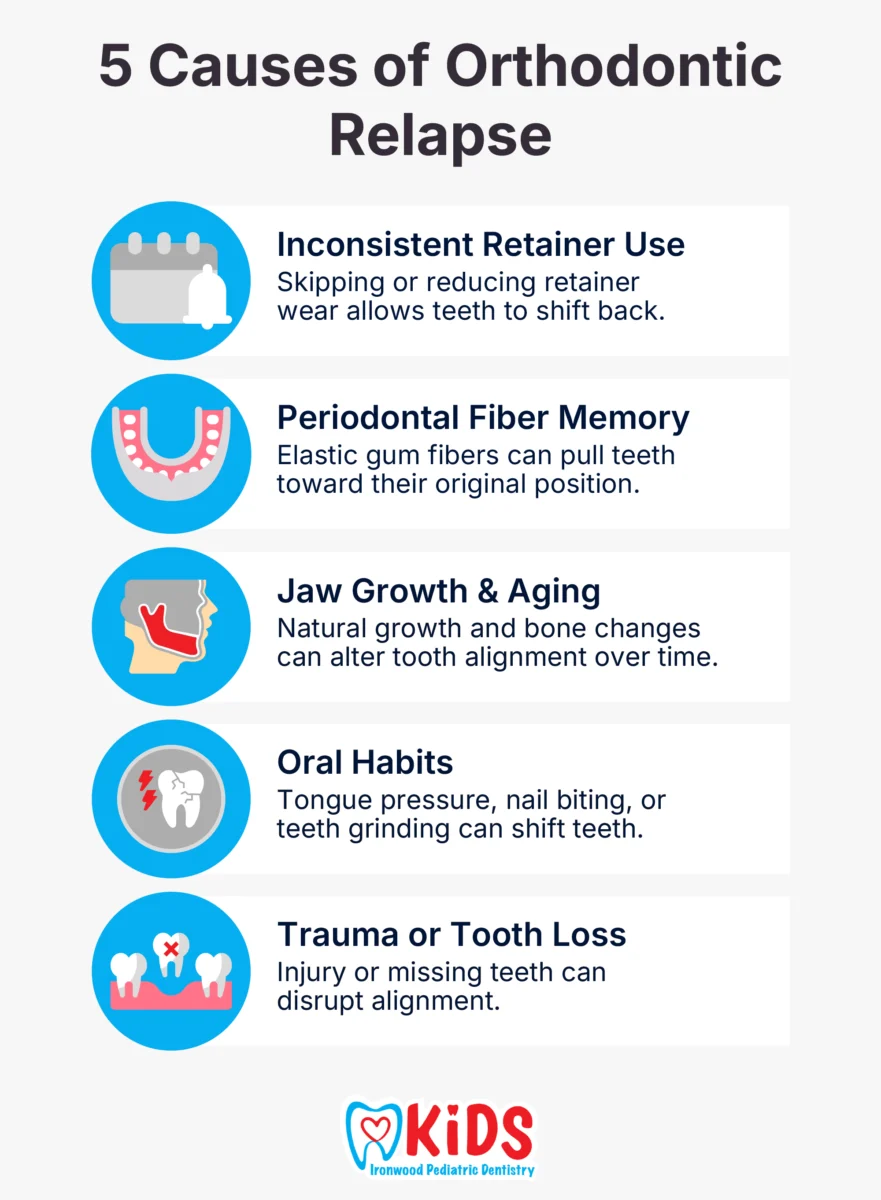
Ineffective Use of a Retainer
Often, the removal of orthodontic appliances like braces is not the end of your child’s orthodontic treatment. To hold the teeth in their new positions, wearing a retainer consistently is often required for a period of time.
Ineffective use of retainers is a leading cause of orthodontic relapse. Although retainers are removable most of the time, they must be used regularly to be fully effective. If they are left out for too long, too often, the teeth tend to shift back to previous positions, and the chance increases that your child will experience some loss of the progress made while wearing orthodontics.
Periodontal Ligament and Gingival Fiber Memory Effect
Your child’s periodontal ligaments and gingival fibers are elastic. By shifting teeth to new positions or alignments, orthodontics can stretch these ligaments and fibers. Once the orthodontics are removed, this elastic quality can assert itself, causing the teeth to be pulled back toward their pre-treatment positions. This is known as fiber reorganization.
Fiber reorganization is a gradual process that can occur over years. Early and consistent use of a retainer is the best way to counter it.
Jaw Growth, Aging, and Bone Remodeling
Braces treatment is often started before your child has stopped growing. Once braces are removed, continued jaw growth can contribute to gradual tooth repositioning.
The older your child gets, into adulthood, the more likely it is that teeth will shift naturally. This is a common occurrence, especially in the front teeth, which can be more susceptible to shifting due to continued oral forces and natural age-related changes.
Bone remodeling may occur when the alveolar bone (the surrounding bone in your child’s upper and lower jaws that forms and supports tooth sockets) is not yet fully developed. This can create an opportunity for teeth to shift.
Oral Habits
Sometimes the way your child chews food, applies tongue or lip pressure, or grinds their teeth can contribute to teeth shifting after braces removal. These behaviors can contribute to tooth movement.
Trauma and Tooth Loss
An injury to the mouth can affect tooth alignment, as can tooth loss from any cause, such as trauma, tooth decay, or periodontal disease.
What Are the Consequences of Orthodontic Relapse?
If your child’s teeth begin to shift back to their original positions, he or she may experience the following effects:
- A less appealing smile because of crooked or crowded teeth
- Difficulty biting, chewing, or speaking clearly
- Increased risk of cavities, gum disease, and jaw joint problems
In effect, an orthodontic relapse can reintroduce many of the oral health issues that led to the need for braces to begin with.
Treatment of Orthodontic Relapse
Various treatments are available to correct shifted teeth caused by orthodontic relapse. The best option for your child depends on factors such as the cause of the relapse, the location of the affected teeth, and the severity of the condition.
Behavioral Correction
If oral habits such as tongue thrusting, nail biting, or teeth grinding are causing teeth to shift after braces, treatment may be as simple as encouraging your child to stop these behaviors. Your pediatric dentist or orthodontist can help you with strategies and methods to encourage new, better oral health behaviors.
Retainer Adjustment or Reissue
In mild cases of orthodontic relapse, making changes to your child’s retainer may be all that is needed. An example is switching from removable to fixed retainer wear.
Comparison of Fixed vs. Removable Retainers
| Feature | Fixed Retainers | Removable Retainers |
| Description | A thin wire bonded to the lingual (tongue‑side) surface of teeth, usually canine‑to‑canine | A removable appliance worn by the patient (e.g., Hawley or clear vacuum‑formed retainer) |
| Patient Compliance Required | Minimal – always in place | High – effectiveness depends on wearing as prescribed |
| Effectiveness for Long‑Term Stability | Generally superior for maintaining anterior alignment, especially lower incisors | Effective when worn consistently; relapse risk increases with inconsistent use |
| Risk of Relapse | Lower relapse rates when intact and monitored regularly | Higher relapse risk if wear is reduced or discontinued |
| Maintenance Requirements | Requires regular professional checks for wire breakage or debonding | Requires patient care, cleaning, and periodic replacement |
| Oral Hygiene Impact | Can complicate flossing and increase plaque retention if hygiene is poor | Easier oral hygiene because appliance is removable |
| Comfort | Generally well-tolerated once adapted | May feel bulky initially; speech changes possible (especially Hawley) |
| Aesthetic Visibility | Invisible from the front | Clear retainers are discreet; Hawley retainers have visible wire |
| Typical Wear Duration | Often recommended long‑term or indefinitely | Full‑time initially, then night‑time long‑term or lifelong |
| Best Use | High relapse risk cases; lower anterior crowding; poor compliance patients | Motivated, compliant patients; cases requiring occlusal settling |
Orthodontic Retreatment
Sometimes treatment can consist of limited braces or clear aligners like Invisalign. In more severe cases, it may be necessary to do a full braces retreatment.
Interdisciplinary Management Methods
In some cases, your child’s orthodontist may need to coordinate with other dental specialists, such as periodontists for periodontal disease or orthopedic surgeons for oral and maxillofacial surgeries.
Can Orthodontic Relapse Be Prevented?
As we mentioned above, sometimes orthodontic relapse can happen, and there is little you or your child can do to stop it. In many other circumstances, you may be able to take proactive steps to reduce the possibility of losing the progress that braces treatment has made.
Effective Retainer Use
If your child is using a removable retainer, regularly wearing it is a good way to head off orthodontic relapse.
If a removable retainer is not enough, a fixed retainer may be sufficient to prevent tooth shifting after braces.
Good Oral Hygiene Habit Changes
The same changes of habits that can treat mild cases of orthodontic relapse can help to keep it from happening in the first place.
Working Closely With Your Pediatric Dentist or Orthodontist
A good way to prevent relapse is to recognize the signs that it is beginning. By maintaining a schedule of regular checkups for your child, you can help your pediatric dentist or orthodontist detect early signs of tooth shifting and take corrective steps to minimize the problem before more serious measures become necessary.
Are You Concerned About Orthodontic Relapse for Your Child?
Although orthodontic relapse does not always happen upon completing orthodontic treatment, depending on your child’s circumstances, it can pose a risk. If your child is wearing braces and is nearing the point when orthodontic treatment will be removed, and you want to help keep his or her teeth from shifting back toward their pre-braces state of misalignment, our child dentists and orthodontists at Ironwood Pediatric Dentistry can help.
Orthodontic relapse is not always inevitable, and in many cases is treatable. Call us at (480) 422-4544 today to speak with one of our child oral health professionals. You can also reach us online.