Hypodontia is a developmental dental condition in which one or more permanent teeth — the adult teeth meant to replace baby teeth — never develop.
Most parents have never heard the word until a routine X-ray brings it up, and learning your child has congenitally missing teeth can be unsettling. It helps to know that this is one of the most common developmental dental conditions, and not the result of anything you did.
If your child has missing permanent teeth or questions about how their smile is developing, Ironwood Pediatric Dentistry provides personalized care in Scottsdale — and we accept AHCCCS and Medicaid.
Call (480) 422-4544 to schedule your child’s appointment.
What Is Hypodontia?
Hypodontia is generally defined as the congenital absence of one to five teeth, excluding the wisdom teeth. Most often, it affects the permanent teeth, though primary teeth can be involved.
The tooth buds simply never formed — a process beginning in the womb that, for some teeth, continues into infancy. A missing tooth is less something that happened to your child than something that was never there.
Hypodontia differs from other forms of tooth agenesis:
- Hypodontia: one to five missing teeth
- Oligodontia: six or more permanent teeth
- Anodontia: complete absence of all teeth, which is extremely rare
How Common Is Hypodontia?
Reported prevalence varies by population, with most research placing hypodontia between roughly 2% and 7% of people once wisdom teeth are set aside. Severity varies from patient to patient, but most children are missing only one or two teeth.
Which Teeth Are Most Commonly Missing?
Hypodontia is not random. A handful of teeth account for most cases, in a pattern that holds steady across studies:
- Lower second premolars — the most commonly missing tooth of all, absent in roughly 1 in 5 cases
- Upper lateral incisors — the small teeth flanking the two front teeth
- Upper second premolars — less common than their lower counterparts
- Lower front teeth — the central incisors at the bottom of the smile
The third molars, or wisdom teeth, go missing more often than any of these, but they sit outside the diagnosis.
Missing Lateral Incisors and Your Child’s Smile
Missing lateral incisors are what families ask about most, because they land in the middle of the smile. They are also among the most predictably treated: orthodontics can move the canine into the gap and reshape it to match, or hold the space for a bridge or implant later.
What Causes Hypodontia?
Several factors may contribute to hypodontia.
Genetics
Genetic factors are the most common cause by a wide margin. Tooth agenesis runs in families, and several genetic variants involved in dental development are associated with the condition. If you or your child’s other parent had a missing adult tooth, mention it at the next visit — it often explains what the X-rays show.
How and When Teeth Form
Tooth buds take shape long before any tooth is visible in the mouth. The front teeth and canines develop around the fifth month of pregnancy, while the second molars and wisdom teeth do not begin until after birth. If a bud fails to form during its window, the tooth will not erupt.
Environmental Factors
Illness during pregnancy, chemotherapy or radiation, a serious childhood infection, or trauma to the jaw while teeth are forming have all been linked to missing teeth. In most children, though, no specific environmental cause is ever identified — so there is very likely nothing you could have done differently.
Medical Conditions
Occasionally, hypodontia appears as one feature of a broader diagnosis. Ectodermal dysplasia, cleft lip and palate, and Down syndrome are all associated with missing teeth. In these cases, we coordinate closely with your pediatrician.
Signs Your Child May Have Missing Permanent Teeth
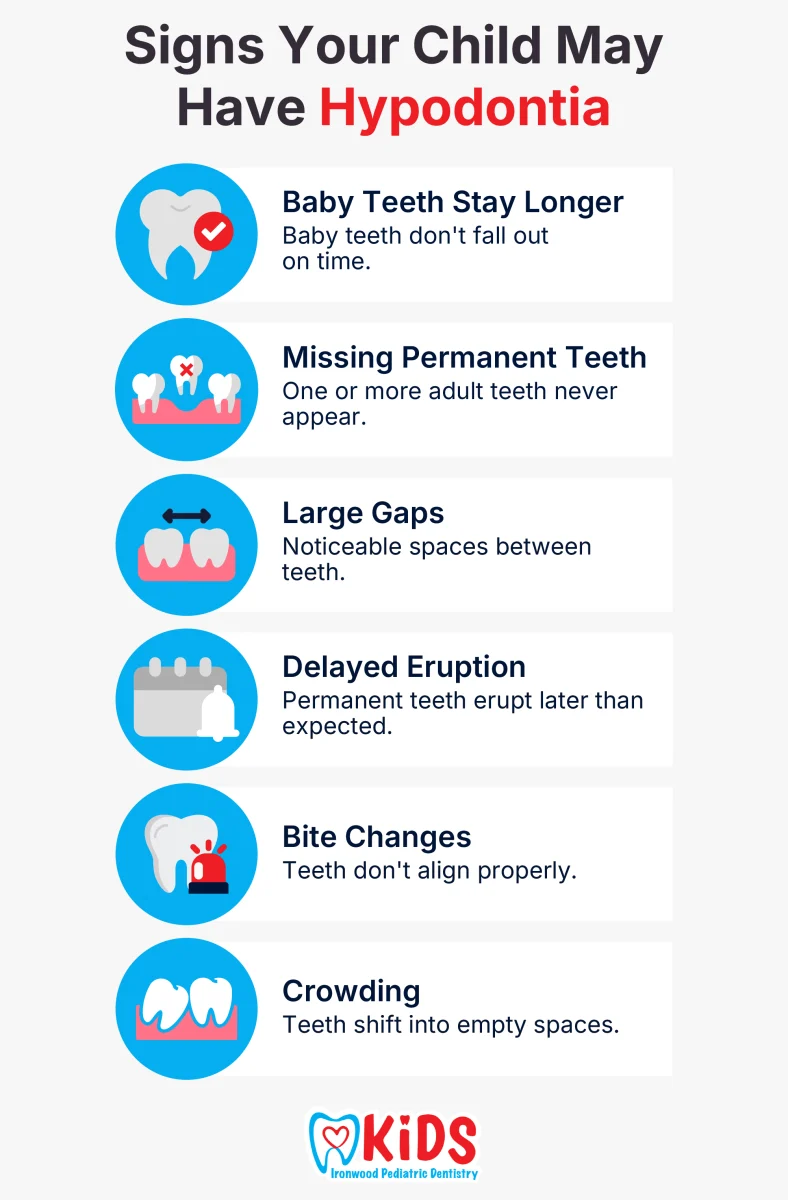
Hypodontia rarely announces itself. There is no pain, so what parents notice first usually depends on timing. Schedule an evaluation if you see:
- Baby teeth staying in place far longer than expected
- Adult teeth that are clearly delayed
- Large spaces between teeth
- Changes in bite alignment, or crowding, as teeth shift
- A family history of hypodontia or tooth agenesis
More often, we spot hypodontia on a routine X-ray before there is anything to notice at home, early, while every option is still open.
How Is Hypodontia Diagnosed?
Diagnosis starts with a clinical examination and dental X-rays. The X-rays are the deciding piece: they show whether the permanent teeth are developing quietly beneath the gums, running behind schedule, or genuinely absent. From there, we assess jaw growth, review your child’s oral health, and ask about family history.
How Missing Teeth Affect Kids’ Development
A missing tooth is easy to think of as a cosmetic issue, and when it sits at the front of the smile, appearance is understandably the first concern. But teeth do more than fill out a smile. Missing back teeth reduce the surface your child chews with, and missing front teeth can shape how certain sounds are formed as speech develops.
Because teeth hold each other in position, a space also changes how the bite comes together across the whole mouth: neighboring teeth drift into the gap, and the jaw grows around the new arrangement. A space that is watched stays a straightforward problem; one left alone for years becomes harder.
Then there is the part that no X-ray shows. Kids notice their own smiles, and they notice when other children do. A visible gap can weigh on a child’s confidence, and it is often why families come in — a legitimate reason to seek treatment, and we treat it as one.
Treatment for Hypodontia in Children
There is no standard treatment for hypodontia, because no two patients arrive with the same situation. What we build depends on your child’s age, their growth, and which permanent teeth are absent.
Often, the right first step is no procedure at all: if your child is young and the bite is stable, we track tooth development and spacing and wait until intervening will accomplish something. Watchful waiting is a decision, not a delay.
Orthodontic Treatment
Orthodontics does most of the heavy lifting, and it works in two opposite directions. Sometimes the goal is to close a gap for good, moving neighboring teeth together so no replacement tooth is ever needed.
Other times, it is the reverse: holding a space open so a bridge or implant has somewhere to go years later. Braces or clear aligners handle both jobs while correcting the bite, and braces are absolutely possible when teeth are missing. The missing teeth are often exactly why they help.
Maintaining Primary Teeth
When no adult tooth is waiting underneath, a baby tooth often has no reason to fall out — and that can be good news. A healthy primary tooth may remain in service for years, preserving the surrounding bone and preventing the space from collapsing. We monitor these teeth closely but do not rush to remove something that is doing useful work.
Replacing Missing Teeth Later
Dental implants, bridges, and removable partial dentures all replace missing teeth, and all belong to a later stage. Implants stay in place while the jaw continues to grow, so they are typically placed until facial growth is complete.
Partial dentures can bridge the growing years, letting a child chew and speak normally in the meantime. These are not services we provide at Ironwood — we plan toward them, protect the space, and connect you with the right restorative dentist when the timing is right.
Contact Ironwood Pediatric Dentistry
Everything about hypodontia gets easier the earlier it is found, which is why regular visits matter.
It also sits at the intersection of pediatric dentistry and orthodontics, so it helps to have both under one roof: our board-certified pediatric dentists work directly with Dr. Michael Hawkins, our board-certified orthodontist, ensuring that monitoring, timing, and the orthodontic plan come from a single team supporting your child’s oral development.
Call Ironwood Pediatric Dentistry today at (480) 422-4544 to schedule your child’s appointment and learn more about treatment for hypodontia.