On average, an infant’s teeth start erupting between 6 and 12 months, and most kids will have all 20 of their primary teeth in place by age 3. This typical timeline is subject to considerable variation, so if your child is a little “behind schedule,” the delay is not necessarily cause for you to worry.
But if your child is experiencing a significant delay in tooth eruption or uneven emergence of teeth, this could indicate other dental issues that you may want to check with your pediatric dentist.
Ironwood Pediatric Dentistry Can Help With Delayed Tooth Eruption Issues
From baby teeth to braces, Ironwood Pediatric Dentistry is proud to serve Scottsdale’s pediatric dentistry needs from our conveniently located office at 10213 N. 92nd Street, Suite H-102, Scottsdale, Arizona 85258. Our experienced pediatric dentists handle all pediatric dental needs, including health issues related to delayed teeth eruption.
Our dental care philosophy centers on early prevention, education, and promotion of good oral hygiene habits and providing quality dental treatment to avoid future dental problems. We can compare your child’s pattern with expected ranges, look for local barriers, and decide whether delayed teething requires simple monitoring or further evaluation.
We are just a phone call away at (480) 422-4544, and we also offer teledentistry services so you can speak to a dentist from your smartphone, computer, or tablet. You can also contact us online to ask a question or set up an appointment with a member of our pediatric dentistry team.
What Is Delayed Tooth Eruption?
Delayed tooth eruption means that either a baby tooth or a permanent tooth has not appeared within the expected time frame for that tooth. A tooth eruption delay is not defined based on your child’s birthday; instead, a pediatric dentist considers the tooth involved, the usual sequence, your child’s overall development, family history, birth history, whether a matching tooth has already erupted on the other side, and other symptoms.
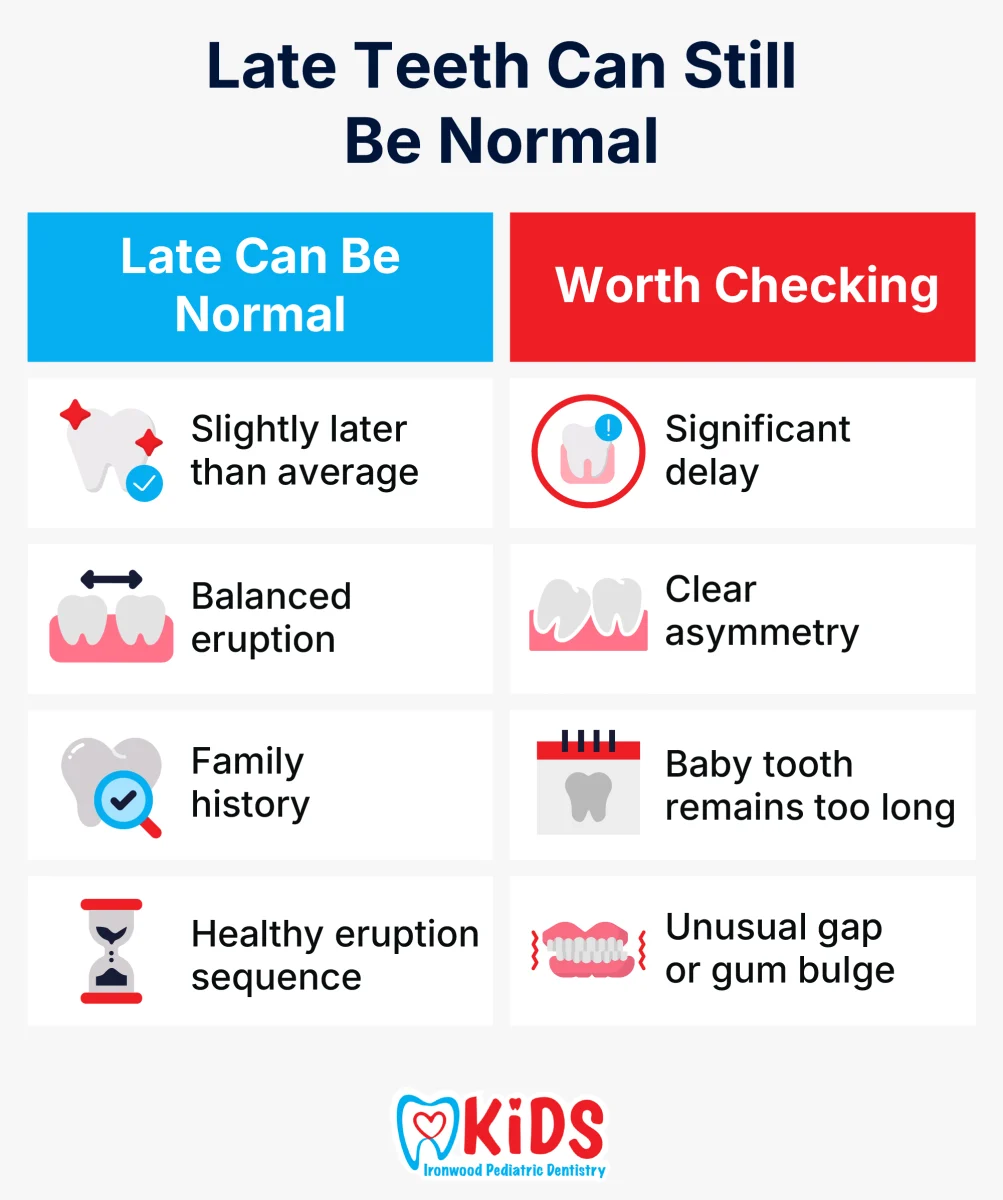
Delayed tooth eruptions must be looked at on a case-by-case basis, because many otherwise healthy infants do not fit inside published developmental milestones. For example, if your child’s teeth come in later than average but still in a balanced sequence, then he or she may simply be following an individual or family pattern. A single tooth that remains unerupted while its partner appears, however, may point to a matter that deserves closer examination.
When Do Baby Teeth Usually Come In?
Your child’s lower central incisors are usually the first teeth you will see, commonly appearing between 6 and 10 months. Next come the upper central incisors at around 8 to 12 months.
Lateral incisors usually emerge between 9 and 16 months, first molars between 13 and 19 months, canines between 16 and 23 months, and second molars between 23 and 33 months.
It is important to remember that children do not always follow this schedule exactly. Teeth can arrive in bursts, pause for several months, and then resume. Most children have all their primary teeth in by around age 3, but instead of measuring by birthdays or average ages, the overall sequence and symmetry are often more useful guides in cases of delayed tooth eruption.
Common Delayed Tooth Eruption Causes
Your child may experience late tooth eruption for any of several reasons. Some of these are not cause to worry; others are genuine reasons for concern. What follows are some of the most frequent causes our pediatric dentists see in our child patients.
Family Timing and Genetic Factors
Eruption timing can run in families. Research supports a genetic contribution by one or both parents to some instances involving retained baby teeth and delayed permanent teeth, although not every late tooth reflects a genetic disorder.
Premature Birth or Low Birth Weight
The teeth of a child born early may appear later than usual. Other evidence suggests a similar conclusion for children with low birth weight. This is why birth history and age can be important parts of a thoughtful evaluation.
Nutritional Deficiencies and Mineral Balance
A balanced diet is important for your child’s healthy development. Severe or chronic undernutrition can be associated with slower teeth eruption. Studies have also found associations between delayed tooth eruption and lower vitamin D or calcium levels, especially for delayed permanent teeth. A pediatric dentist or pediatrician can decide whether a dietary review or medical testing is appropriate for your child.
Endocrine or Medical Conditions
Hypothyroidism is an endocrine condition associated with delayed dental development. Delayed tooth eruption alone cannot diagnose hypothyroidism; your child’s dentist may coordinate with your pediatrician when examination suggests a broader concern.
A Local Barrier or Altered Eruption Path
Sometimes a tooth is present under the gum but cannot follow its usual path. Possible explanations for this kind of late teething include an extra tooth, teeth crowding, an abnormal tooth position, impaction, or an ankylosed tooth that has fused to surrounding bone.
These causes are relevant when one tooth is delayed, the left and right sides look very different, or a baby tooth remains long after its expected shedding time.
How a Pediatric Dentist Evaluates Delayed Tooth Eruption
When examining your child for a delayed tooth eruption during a first dental visit, your pediatric dentist may ask about pregnancy and birth history, prematurity or low birth weight, medical diagnoses and medicines, nutrition, growth, trauma, and family tooth timing.
A thorough exam then looks at the gums, erupted teeth, spacing, symmetry, bite, and the shape of the developing arches.
Dental imaging is not always needed, but an intraoral or panoramic image can help confirm whether an unerupted tooth is present, estimate its development and position, and look for extra teeth, impaction, or another obstruction.
If your child’s teeth development appears healthy, then the best plan may be to follow up with periodic monitoring. If your dentist suspects a nutritional, growth, or endocrine concern underlies a delayed eruption, then our dental team may recommend coordinating with your pediatrician rather than trying to diagnose a medical condition from the mouth alone.
If dental imaging identifies a local barrier or space problem, then one of our dentists can explain appropriate options and timing. Some children need observation only, while others may benefit from coordinated pediatric dental, orthodontic, surgical, or medical care.
When Should You Be Concerned About Delayed Tooth Eruption?
The American Association of Pediatric Dentists recommends that you should establish a dental home for your child by age one, or within six months of the first tooth eruption. So, one practical threshold of concern about delayed tooth eruption is if your child has not shown any tooth eruption by 18 months. This does not automatically mean something is wrong, and it is not usually an emergency, but it is a sensible point to schedule a pediatric dental evaluation.
Call a dentist at Ironwood Pediatric Dentistry if you notice any of the following:
- A large delay for a particular tooth, especially when it is well outside the expected range.
- A clearly asymmetric pattern, with a tooth erupting on one side but not the other.
- A baby tooth remains firmly in place while its permanent replacement appears overdue.
- An unusual gap or persistent gum bulge appears.
- Delayed tooth eruption occurs together with poor growth, marked fatigue, constipation, feeding concerns, or another developmental issue.
- Your child has a history of oral trauma, a known endocrine or genetic condition, or a strong family history of eruption problems.
These signs are reasons for evaluation, not reasons to panic. The goal in having them evaluated is to distinguish a healthy late bloomer from a child who could benefit from monitoring, medical collaboration, or timely dental care.
Personalized Pediatric Dental Care in Scottsdale, Arizona
For Arizona families seeking pediatric dental care in Scottsdale, Ironwood Pediatric Dentistry provides care for infants, children, teens, and patients with special needs in a safe, nurturing environment. Our practice emphasizes early prevention, long-term oral health, education, and quality treatment, and our pediatric dental specialists have additional training focused specifically on caring for children.
If you are worried about delayed tooth eruption, you do not have to interpret a chart alone. A calm, personalized evaluation can give your family clearer answers and a plan built around your child.
Call Ironwood Pediatric Dentistry at (480) 422-4544, or you can use our online contact form to request an appointment at our office at 10213 N. 92nd Street, Suite H-102, Scottsdale, AZ 85258.