
Yes, Invisalign is a great option for fixing an overbite.
Overbite is a common problem for children, but fortunately, it can be effectively corrected through orthodontic treatment. One option for mild to moderate overbite in children is Invisalign, a brand of virtually invisible, clear plastic aligners.
The Ironwood Pediatric Dentistry office in Scottsdale, Arizona, is an authorized provider of Invisalign treatment for overbite correction and other orthodontic treatments.
To learn more about Invisalign treatment as an alternative to traditional braces for overbite correction and to set up an appointment for your child with one of our pediatric dentists and orthodontists, call us at (480) 422-4544.
What Are Overbite Causes and Symptoms?
In a normal, healthy bite, your upper front teeth cover your lower front teeth by a small margin. This slight overbite or protrusion enables your front teeth to cut food.
Overbite is the term dentists use to refer to a malocclusion of the front teeth, usually reflected by an overlapping gap of more than two to four millimeters (what is considered a normal overbite).
Overbite or protruding teeth take two forms:
- Vertical overbite: In this variation, the top front teeth overlap the lower teeth more than they should with a healthy bite. This is also known as a “deep bite.”
- Horizontal overbite: This kind of overbite, also known as an overjet or “buck teeth,” happens when the upper front teeth tip forward beyond the lower front teeth.
An overbite condition can be mild, moderate, or severe. Invisalign treatment for overbite is most effective for mild to moderate overbites.
Overbite Causes
Overbite can be caused by genetic factors affecting your child’s jaw shape or tooth alignment. Other overbite causes include:
- Excessive nail biting
- Teeth grinding
- Pushing the tongue against the front teeth
- Thumb-sucking or pacifier use that persists past the age of three years
Overbite Symptoms
A mild overbite does not always require treatment. But the worse the overbite, the more likely it is to lead to other problems that, if left untreated, can become more serious. These problems include:
- Excessive tooth enamel wear
- Chipping or fracturing of the front teeth
- Difficulty chewing
- Jaw pain, headaches, or temporomandibular (TMJ) disorders
- Speech impediments
- Gum recession
- Bone loss
If your child is experiencing any of these symptoms because of an overbite, it is a good idea to fix the overbite sooner rather than later.
Can Invisalign Fix Overbites?
Invisalign treatment can be effective for mild, moderate, and severe overbites, but the approach changes as the case gets more complex.
For mild overbites, Invisalign aligners alone can usually move the teeth into a corrected position. Treatment tends to be faster in this group—most cases finish within 6 to 12 months—and the success rate is very high.
For moderate overbites, where most patients fall, Invisalign almost always works best with a few extra tools alongside the aligners. The most common are tooth-colored attachments, small bumps bonded to specific teeth that give the aligners more grip and leverage for precise movements. Some moderate cases also use elastics. Treatment typically runs 12 to 18 months.
For severe overbites, Invisalign reaches its limits as a standalone treatment. Many severe cases can still be corrected by combining aligners with attachments and elastics, but progress is slower (18 to 24 months or more), and results may be partial.
For severe skeletal overbites—those caused by the jaw being out of position rather than just the teeth—traditional braces, or in some cases jaw surgery, deliver more predictable results.
Your child’s pediatric dentist or orthodontist can diagnose the extent of your child’s overbite and recommend the appropriate treatment plan.
How Does Invisalign Overbite Treatment Work?
Invisalign treatment consists of a customized plan that can last 6 months or up to 2 years.
Your child’s unique Invisalign overbite treatment begins with a free initial consultation appointment at our Scottsdale office. During this consultation, we will thoroughly scan your child’s mouth and teeth using the iTero Element® scanner, which takes 6,000 images every second to create a comprehensive map of the mouth and jaws.
Next, we use Invisalign’s ClinCheck® software to turn the electronic data from the iTero Element scan into a three-dimensional model of your child’s mouth and jaws. Based on this highly detailed model, we use treatment planning software to prepare a customized treatment plan.
Your child will wear each Invisalign aligner for a few weeks as the teeth slowly shift to their new positions. Each aligner must be worn for about 20 to 22 hours a day; they should only be removed when eating, brushing, flossing, or cleaning the aligner.
Your child will receive a succession of Invisalign clear plastic aligners throughout treatment. Each aligner will be slightly different than the one before it, and will be formed to pick up where the prior aligner left off.
During Invisalign treatment, we will have your child return to our offices so we can check on treatment progress, issue the next set of aligner trays, and answer any questions you may have.
How Long Does Invisalign Take for Overbite Correction?
Invisalign can treat most overbite cases in 6 to 24 months. The duration depends on the severity of the overbite, the patient’s age, and the consistency with which the aligners are worn.
The table below summarizes the possible treatment time ranges for Invisalign in overbite correction.
| Overbite Severity | Typical Invisalign Duration | Notes |
|---|---|---|
| Mild | 6–12 months | Teeth are mostly aligned; fastest cases |
| Moderate | 12–18 months | Most patients fall here; requires consistent 20–22 hours daily wear |
| Severe | 18–24+ months | May require attachments, elastics, or combination therapy |
Invisalign Overbite Before and After: What to Expect
Before Invisalign overbite treatment starts, the iTero Element scan and ClinCheck software let us build a 3D preview of where the teeth and bite will end up. Most parents and patients are surprised by how much detail they can see in the projected outcome before the first aligner is even worn.
By the end of an Invisalign overbite case, before-and-after results typically show:
- A more balanced bite, with the upper and lower teeth meeting cleanly
- Easier chewing and clearer speech
- Less strain on the jaw and fewer TMJ-related symptoms
- Healthier gums and more even tooth color than is typical when traditional braces come off, because aligners come out for brushing, flossing, and cleaning
- A more confident smile
Every smile is different, but the pattern is consistent: better bite function, healthier gums, and a more even appearance. Photos of before-and-after Invisalign overbite cases are available during your free consultation at our Scottsdale office.
What Are The Benefits Of Choosing Invisalign For Correcting An Overbite?
For many kinds of orthodontic issues, Invisalign treatment is popular with patients as an alternative to braces for three main reasons:
Invisalign Aligners Are Virtually Invisible
Although they are not completely invisible, Invisalign aligners are less conspicuous when worn than traditional metal braces. Invisalign aligners are an exciting option for children who would otherwise feel self-conscious and socially awkward wearing regular braces.
Invisalign Aligners Are Removable
Once applied, braces can only be safely removed by an orthodontist. This can make it harder to keep teeth clean by brushing and flossing, and can lead to teeth staining and uneven coloration. Once braces are removed, a professional cleaning and tooth-whitening procedure is often necessary to restore teeth to a uniform shade.
Unlike braces, Invisalign aligners are easily removable by the patient. This makes it much easier to keep teeth clean and to apply over-the-counter tooth whitening products. Invisalign also does not require an “off-limits” food or beverage list.
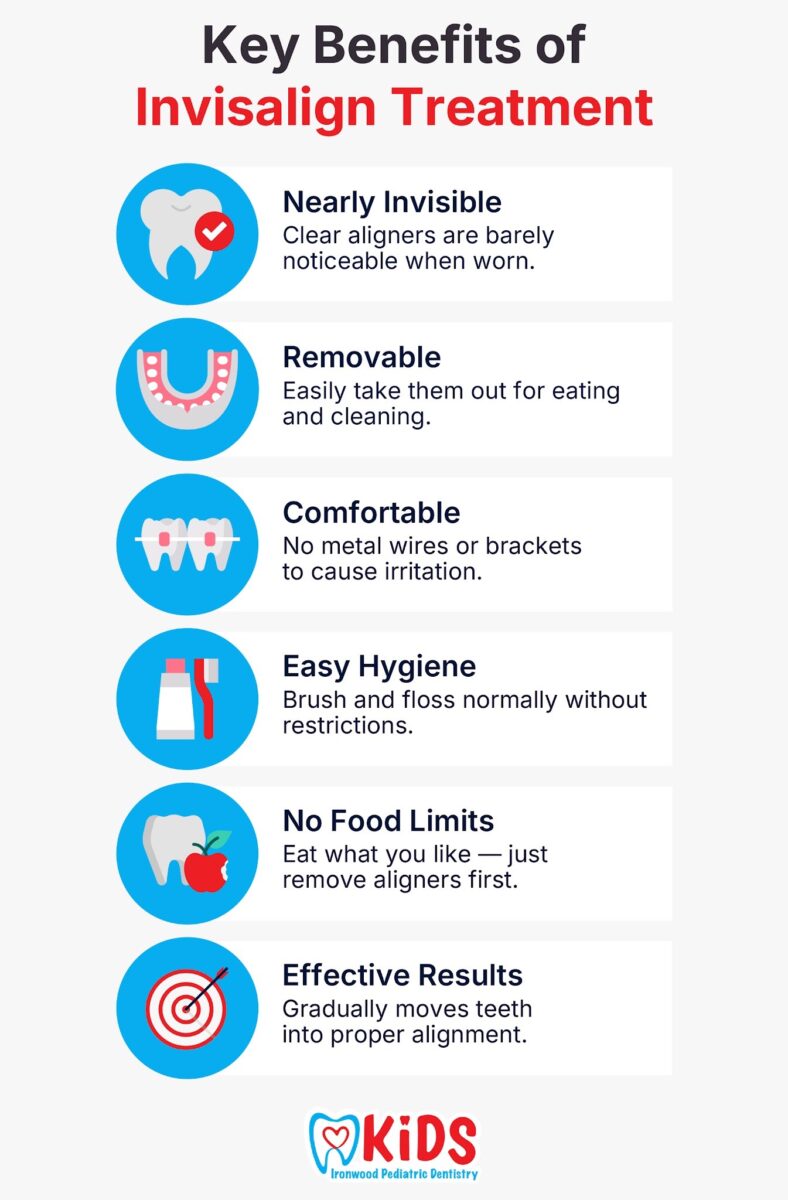
Invisalign Aligners Are Comfortable to Wear
Traditional braces can be uncomfortable. When something goes wrong with metal braces, like a broken archwire or a broken bracket, they can even become painful until you go to the orthodontist to fix them. Having no wires or brackets eliminates this potential for pain.
Invisalign for Overbite in Children and Teens
The standard Invisalign treatment process works well for teens. Invisalign overbite treatment using Mandibular Advancement (MA) is best for children ages 9–14 while their jaw is still growing. These MA aligners have plastic wings attached to them and are the first FDA-cleared clear aligner system designed to advance the lower jaw.
Unlike other treatments, such as Herbst or Twin Block appliances, the Invisalign MA treatment process requires no metal hardware and provides simultaneous orthopedic and orthodontic correction while allowing normal brushing, flossing, sports, and instrument playing.
| Feature | Standard Invisalign | Invisalign With Mandibular Advancement |
|---|---|---|
| Best for | Dental overbites | Skeletal Class II overbites |
| Jaw growth modification | No | Yes (precision wings) |
| Appliances needed | Sometimes elastics | None beyond aligners |
| Visibility | Nearly invisible | Nearly invisible |
| Comfort | High | High; more comfortable than fixed appliances |
| Simultaneous tooth + jaw correction | Teeth only | Teeth + jaw |
For dental overbites, standard Invisalign aligners—typically paired with tooth-colored attachments and elastics—work just as well in adults as in teens, with the same nearly invisible appearance and removability that make Invisalign attractive in the first place.
Another technique that can be used with Invisalign is elastics. Similar to the rubber bands worn with traditional braces, the elastics gradually move the bottom teeth forward while moving the upper teeth back.
What Affects How Well Invisalign Works for Overbites?
One of the main advantages of Invisalign treatment – the removability of the aligner trays – also means that you and your child must use them diligently and consistently for them to be optimally effective.
Below are some of the responsibilities your child will have to ensure he or she gets the best results from using Invisalign.
Invisalign Aligners Must be Worn for the Recommended Time
If your child is not wearing clear aligners for the recommended duration of 20 to 22 hours per day, the treatment plan will not keep up with where it needs to be. This can cause problems that require revisiting the treatment plan, delay your results, and possibly increase the cost of treatment.
Invisalign Aligners Require Proper Care When Removed
Another potential problem with using Invisalign aligners is that if they are not kept clean or if your child does not remove them when eating or drinking anything other than water, they can become stained or damaged.
- Staining can occur when drinking dark-colored beverages like dark fruit juices, soft drinks, or coffee while wearing clear aligners, or when the aligners are put back in after drinking without first brushing the teeth.
- Because Invisalign aligner trays are made of plastic, cleaning them with too hot water can cause them to warp.
- If your child does not practice good dental hygiene while wearing Invisalign, the aligners can rub against the teeth and gums, leading to food particles accumulating and contributing to tooth decay and periodontal health problems such as gingivitis and periodontal disease.
When Might Braces Be a Better Choice Than Invisalign to Treat Overbite?
Although the gentle pressure from Invisalign treatment can be used in many overbite cases, orthodontists often prefer braces for more severe overbites because they deliver stronger, constant force and allow for more precise control of your child’s tooth and jaw movement.
Traditional metal braces can treat severe cases that may take up to three years, while Invisalign typically handles mild–to-moderate cases in 6–24 months.
Cases in which braces may achieve optimal results include:
- Cases requiring complex tooth movements and jaw alignment
- Skeletal overbites that require additional appliances
- Patients who have trouble complying with Invisalign’s 20-22-hour-per-day consistent wear requirement
- Budget-sensitive situations (braces cost on average $4,500 to $8,000, while Invisalign is around the same)
Can Invisalign Fix Other Bite Problems?
Aside from overbites, Invisalign removable aligners can also effectively correct open bites, underbites, and crossbites.
Where Can I Find an Invisalign Orthodontist in Scottsdale?
At Ironwood Pediatric Dentistry, our orthodontists are authorized Invisalign dentists trained to use Invisalign diagnostic equipment, such as the iTero Element scanner and ClinCheck software, to determine whether your child is a candidate for Invisalign treatment and create a personalized treatment plan for teeth straightening and a smile recovery plan just for your child.
Your first professional consultation with an experienced Invisalign doctor is free.
If Invisalign treatment is right for your child, call our experienced orthodontists today at (480) 422-4544 or contact us online.