Jaw pain that occurs only on one side of your child’s mouth can happen for several reasons, including dental problems involving a tooth, chewing muscles, or the temporomandibular joint (TMJ) in front of the ear. Persistent or severe cases of this kind of problem can lead to further complications that can have a serious negative impact on your child’s quality of life, including problems with eating and difficulty speaking.
The location of the pain alone is not always a good way to identify the cause of jaw pain. This is why if your child tells you that his or her jaw hurts on one side of the mouth, it is a good idea to call Ironwood Pediatric Dentistry at (480) 422-4544 to schedule a dental examination to find the source of the problem and to recommend effective treatment options.
Ironwood Pediatric Dentistry Can Help Your Child With Dental Pain
At Ironwood Pediatric Dentistry, our team of pediatric dentists and orthodontists has the training and experience to treat all kinds of pediatric dental issues for patients ranging from infants to teenagers, including joint pain. We use state-of-the-art equipment designed with your child’s safety foremost in mind, and we work with families to accept many forms of payment, including private insurance policies, AHCCCS, KidsCare, and financing arrangements.
We offer extended office hours on select days, dental appointment reminders, and a quick turnaround time on calls and appointment requests. We are happy to answer any questions or concerns in our office, over the phone at (480) 422-4544, or via email. You may also use our online appointment form.
The Most Common Causes of One-Sided Jaw Pain in Children
What follows are factors causing jaw pain on one side of the mouth that our dentists frequently see in our child patients.
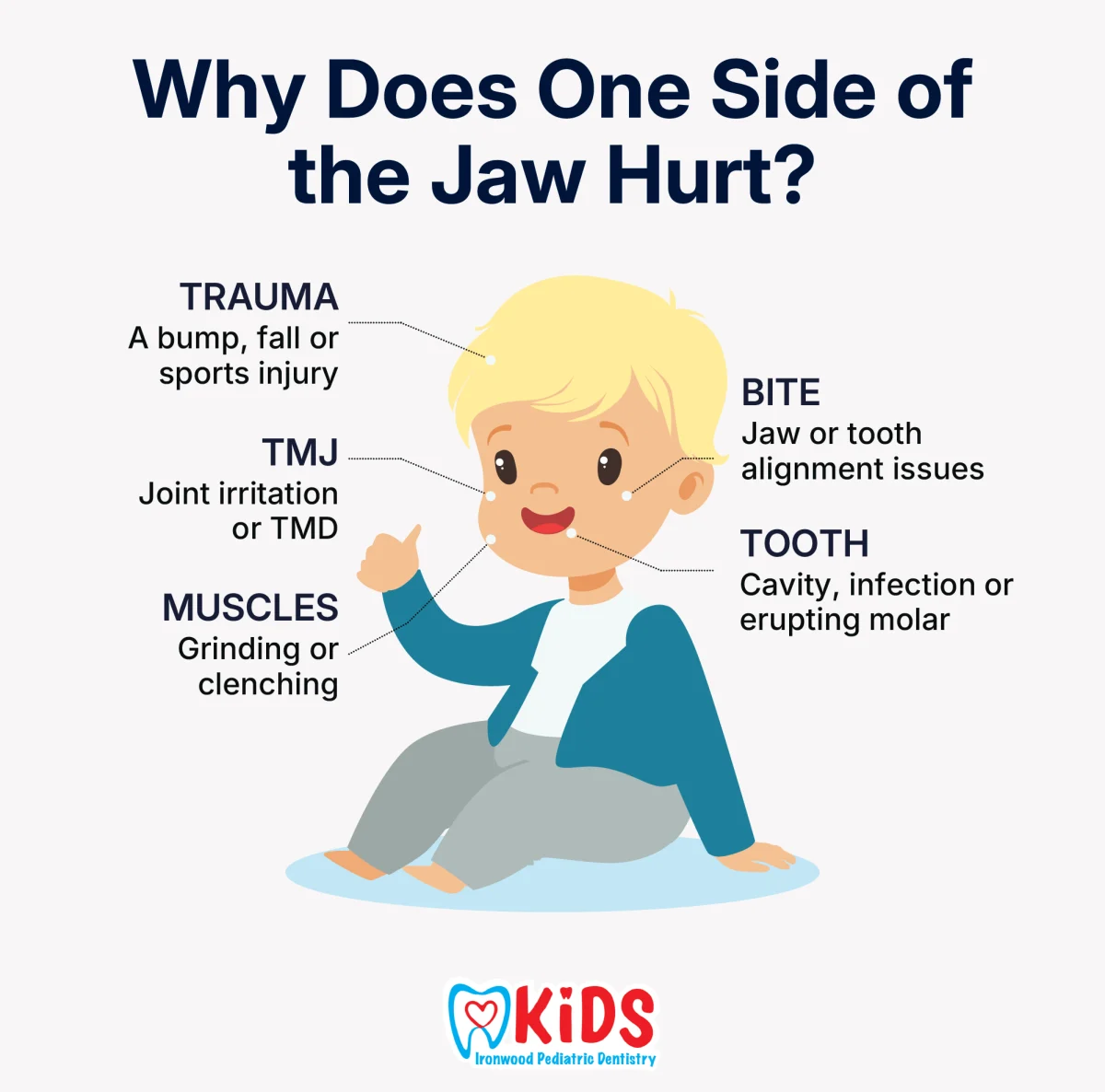
Temporomandibular Joint Irritation or Temporomandibular Disorder (TMD)
The TMJ connects the lower jaw to the skull, while TMD is the broader name for TMJ disorders affecting that joint, the surrounding muscles, and nearby structures, although TMD is not always caused by misaligned teeth.
Your child may feel pain on one side if a joint or jaw muscle group on that side is irritated. Watch for pain with chewing or when yawning, tenderness near the ear, clicking or popping in the jaw, headaches, limited jaw movement, or a jaw that catches or locks up.
An occasional painless click or popping sound does not always require treatment, but pain, repeated locking, a changing bite, or difficulty opening the mouth are all grounds for a dentist’s evaluation, starting with a health and pain history, a clinical examination, and imaging if needed.
Teeth Grinding or Clenching
Teeth grinding or clenching, also known as bruxism, is repetitive grinding or clenching during sleep or while awake. Bruxism can overwork the muscles and the TMJ, resulting in morning jaw soreness, facial or ear pain, headaches, or worn or chipped teeth.
You may hear your child’s nighttime teeth grinding even when he or she is unaware of it. Because bruxism has several possible causes, we recommend scheduling a diagnostic examination appointment rather than using an over-the-counter nightguard without an assessment.
A Bump, Fall, or Sports Injury
A blow to your child’s chin or face can bruise muscles, injure a tooth, irritate the TMJ, or fracture the jaw. Prompt dental assessment is important if severe jaw pain follows trauma and is accompanied by any of the following symptoms:
- Swelling or numbness
- Bleeding
- Loose or broken teeth
- Trouble chewing
- Limited range of motion when opening the jaw
- A bite that suddenly feels “off”
- A jaw that looks out of position
Note: Trouble breathing after a facial injury is a health emergency for which you should seek immediate medical treatment by a doctor.
Bite or Jaw Alignment Concerns
A crossbite, open bite, a pronounced overbite, or other issues with misaligned teeth may be associated with TMD-type pain in some children. An uneven bite or jaw shift should be evaluated by a dentist.
A Cavity, Bacterial Infection, or Erupting Molar
Dental pain can feel like jaw pain, especially from a back tooth. A cavity or inflamed tooth pulp may cause sensitivity to cold, heat, or sweets, throbbing, tenderness, or pain while chewing.
Swelling, fever, a gum pimple, drainage, or feeling unwell may suggest an infection. In younger children, an erupting molar may make the gum tender, while in older teens a partially erupting wisdom tooth can inflame or infect nearby gum tissue.
Note that facial swelling, fever, or signs of infection require prompt dental evaluation.
Common Symptoms You Should Watch For in Your Child
You can help to identify the source of one-sided jaw pain by observing when the pain occurs and what accompanies it. The following clues can help separate tooth pain from muscle, joint, bite, and trauma-related causes:
- Pain while chewing or opening wide
- Clicking, popping, catching, or locking
- Reduced jaw motion
- Morning soreness
- Headaches
- Facial or ear-area pain
- Swelling
- Fever
- Tooth sensitivity
- A recent injury
- Whether your child avoids one side when eating or cannot comfortably eat or speak
At-Home Care While You Arrange an Evaluation
For mild jaw pain symptoms without warning signs, let the jaw rest briefly. Offer soft foods, pause gum and chewy or crunchy foods, and discourage your child from opening his or her mouth excessively wide.
A wrapped ice pack can help relieve your child’s discomfort after a recent injury. For TMD-type soreness, gentle cold or warmth may help your child feel more comfortable. Do not place heat over new facial swelling that could represent infection.
If medication is needed to relieve pain, ask one of our pediatric dentists or your pediatrician which product is appropriate, and follow age- and weight-based directions and the label. Acetaminophen and nonsteroidal anti-inflammatory medicines like ibuprofen are first-line options for acute pediatric dental pain when appropriate, but they do not replace treatment of the underlying cause of the pain.
When Should My Child See a Dentist?
We recommend scheduling an appointment with us if any of the following apply to your child’s jaw pain on one side:
- Pain that persists, returns, or worsens
- Intense pain that interferes with sleep
- Pain that comes with grinding or joint sounds
- Headaches
- Tooth sensitivity
- Pain accompanied by a bite change
- Facial or gum swelling
- Fever
- Drainage or a dental abscess
- Pain caused by significant trauma
- A loose, broken, or cracked tooth
- Difficulty opening or closing the mouth
Go to emergency care for trouble breathing, eating or swallowing, uncontrolled bleeding, a visibly displaced jaw, or a jaw locked open or closed.
Call Ironwood Pediatric Dentistry for Your Child’s Jaw Pain Care
At Ironwood Pediatric Dentistry, we know that experiencing jaw pain can unsettle your child and you. Our Scottsdale dental care team cares for children, teens, and patients with special needs in a nurturing, child-friendly setting.
With pediatric dental and orthodontic services in one practice, we can examine the teeth and gums, bite, jaw movement, muscles, and TMJs, then recommend a personalized, comfort-focused plan based on your child’s needs.
We treat dental emergencies and can often offer same-day care. Virtual consultations are available when you are unsure how urgent a jaw pain concern may be.
If your child has one-sided jaw pain, reach out to us rather than guessing. Request an appointment online or call Ironwood Pediatric Dentistry at (480) 422-4544 to schedule a thoughtful evaluation at our Scottsdale office.