
Tongue thrust describes a pattern in which the tongue presses against or between the front teeth during swallowing. A persistent forward-resting posture, speech or eating difficulties, changes in bite, or breathing concerns may warrant evaluation. A swallowing pattern alone does not always need treatment.
Persistent tongue-position or movement problems may be part of an orofacial myofunctional disorder. It is also related to a child’s tongue being in the wrong position when not swallowing, such as holding it forward at rest or placing it between the front teeth while speaking.
Swallowing patterns change as children develop, but there is no single age that determines whether treatment is needed. The child’s resting tongue posture, bite, speech, eating, breathing, and overall development are more useful than age alone.
A sustained forward tongue resting posture may affect tooth position, while the tongue may also adapt to an existing open bite. Mouth breathing and facial growth have a complex relationship; tongue thrust alone does not establish the cause of facial or skeletal changes.
Ironwood Pediatric Dentistry Can Help Your Child With a Tongue Thrust Habit
A tongue-thrusting habit is not always easy for parents to spot on their own. Our child dentists at Ironwood Pediatric Dentistry have the training and experience to identify a tongue-thrust reflex and can help treat it.
If you bring your child to us for regular check-ups, we can detect tongue thrust concerns early and determine whether monitoring, treatment, or specialist care is appropriate.
If you think that your child might have a tongue-thrust problem or need to schedule a check-up or a dental cleaning, call our Scottsdale office at (480) 422-4544 during our office hours, or you can reach us online at any time.
What Causes Tongue Thrusting in Children?
Tongue thrusting is a natural reflex in infants. This infantile swallowing pattern helps them to feed from a breast or a bottle. As a child grows older and stops breastfeeding or bottle-feeding, tongue thrusting usually gradually decreases and eventually ceases in favor of a normal swallowing pattern.
In some situations, though, this normal progression gets delayed, and a tongue-thrusting habit can form in later childhood, continue through adolescence, and even persist into adulthood.
Several factors that can contribute to a tongue thrust habit are well known to dentists. They include:
- Enlarged tonsils or adenoids. These can narrow the upper airway and contribute to mouth breathing or altered tongue posture.
- Ongoing nasal congestion or allergies. These can make breathing through the nose harder, leading a child to breathe through the mouth instead; this tends to pull the tongue down and forward.
- Prolonged use of a bottle or pacifier, or finger sucking that continues well past the age when most children stop. These practices can prolong tongue thrusting and “train” the tongue muscles to rest low and forward.
- Restricted tongue movement or other structural differences. A qualified clinician can assess whether these contribute to the child’s symptoms.
What Are the Signs and Symptoms of Tongue Thrust?
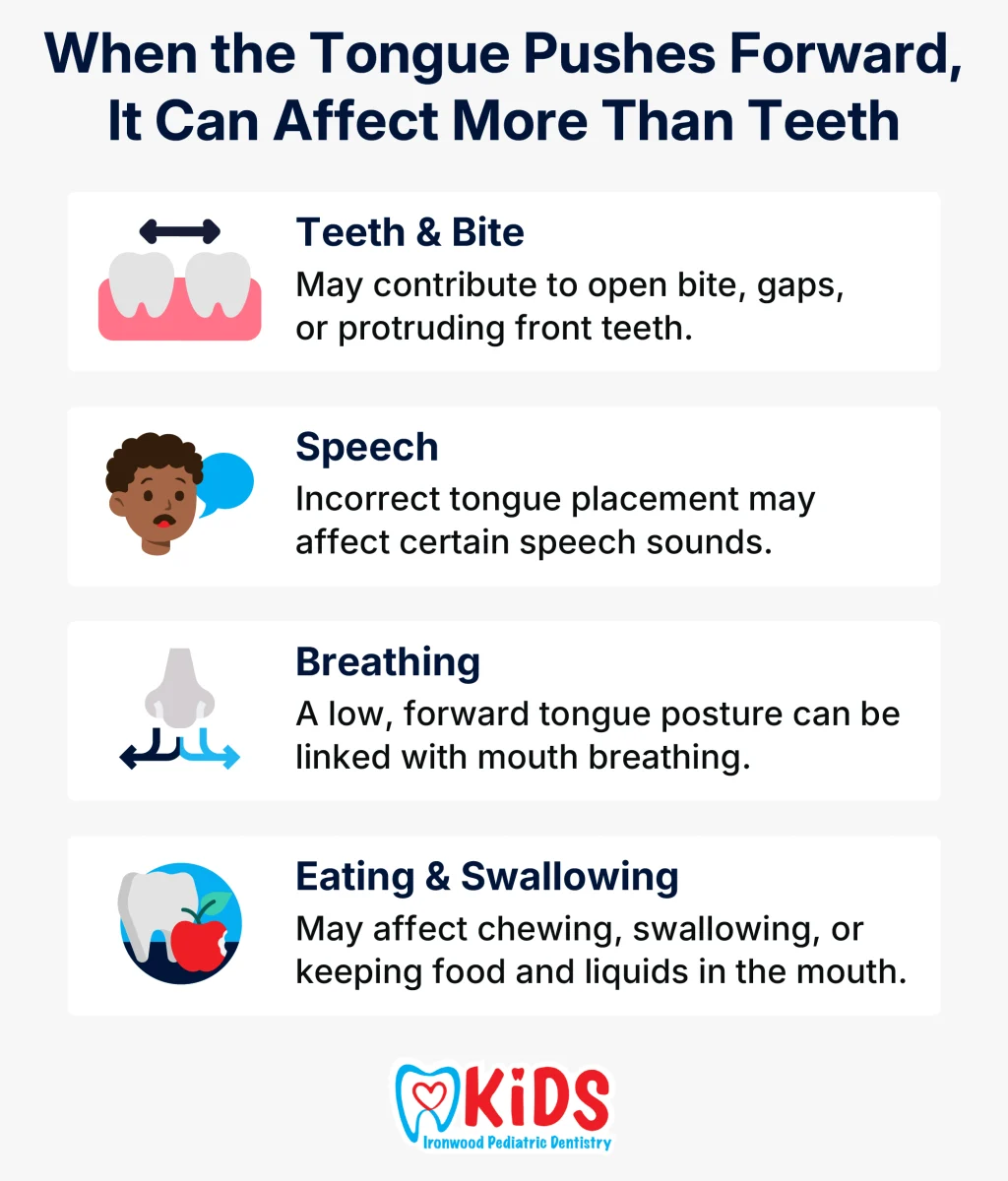
The most common sign of a tongue thrust that you might see is when your child’s tongue protrudes between the upper and lower teeth when swallowing, speaking, or resting.
Other symptoms might include the following:
- Mouth breathing, or an open-mouth resting tongue posture.
- Difficulty articulating certain speech sounds.
- Bite differences, such as an anterior open bite or protruding upper front teeth (increased overjet)
- Tongue resting between the front teeth.
- Gaps between the top and bottom front teeth.
- Inability to fully close the lips.
- Difficulty with chewing solid foods efficiently, or keeping foods and liquids inside the mouth when eating, or difficulty swallowing.
- Changes in facial structure.
- Thumb sucking.
- Teeth grinding.
What Can a Pediatric Dentist Evaluate?
An Ironwood Pediatric Dentistry child dentist can examine your child’s teeth, bite, jaw relationships, lip closure, oral habits, and the tongue’s position at rest and during swallowing. The dentist may also ask about eating, speech, nasal breathing, sleep, orthodontic history, and habits such as thumb or finger sucking.
The goal is not simply to identify a “bad habit.” It is to determine whether:
- The tongue position is affecting the developing bite.
- The tongue may be adapting to an existing open bite.
- Breathing or airway concerns need medical attention.
- Eating or swallowing is affected.
- The condition impacts speech development.
- Treatment, referral, or careful monitoring is the most appropriate next step.
Most of these determinations can be observed during routine visits, since our dentists check growth and alignment with every routine visit your child has.
A few situations, however, can call for more specialized attention. For example, if your child snores most nights, seems to breathe through the mouth constantly rather than occasionally, or you notice a gap opening between the upper and lower front teeth even at rest, that combination is worth mentioning before the next scheduled checkup.
The same applies if your child’s speech clarity seems consistently affected.
Consider mentioning these patterns to your pediatric dentist if they are persistent, appear when your child is relaxed, or occur with dental, breathing, eating, or speech concerns.
How is Tongue Thrust Treated?
Tongue thrust treatment depends on the underlying cause, your child’s age and development, oral habits, airway considerations, dental and orthodontic findings, functional concerns, and ability to participate in care.
There is no single treatment to correct tongue thrusting that is right for every child.
Your child’s unique treatment plan at the dentist’s office may include:
- Monitoring. Observation may be appropriate when the finding is mild, transitional, limited to swallowing, or not affecting rest posture, dental development, speech, eating, or breathing.
- Supportive habit changes. When an ongoing oral habit contributes to the pattern, age-appropriate counseling and behavior-based strategies may be appropriate.
When Might Other Professionals Help?
In more pronounced cases where tongue thrusting leads to other oral health complications, your child’s dentist may recommend coordinating with one or more other specialists to create a treatment plan. The table below shows some of these situations and the specialist who can help with successful correction.
| Type of Professional | When a coordinated evaluation may be helpful |
| Orthodontist | Orthodontic treatment can help with an open bite, protruding teeth, other bite discrepancies, or concerns about jaw and permanent-tooth development.An orthodontist can determine whether observation, an orthodontic appliance, braces, aligners, or another approach is appropriate to move misaligned teeth into their correct positions.Note, however, that an uncorrected tongue thrust habit can lead to orthodontic relapse after orthodontic treatment. |
| Speech-language pathologist (SLP) | Clear speech relies on coordinated movement and placement of the tongue, lips, and other speech structures. An SLP can help when speech problems, chewing, swallowing, food containment, or drinking are concerns with your child’s development.A speech pathologist trained in orofacial myofunctional disorders may assess oral structures, articulation of certain sounds, eating and drinking, swallowing patterns, and tongue placement as part of speech therapy. |
| Myofunctional therapist | Myofunctional therapy can improve tongue elevation, strength, and mobility through targeted exercises to correct tongue and lip resting posture, oral awareness, and swallowing techniques.A dentist or orthodontist may consider a habit appliance, such as a tongue crib, in selected cases as part of a coordinated plan.Myofunctional therapy should address a clearly identified functional need and be coordinated with dental, orthodontic, speech, or medical care as appropriate. |
| ENT—ear, nose, and throat specialist | When persistent mouth breathing, nasal obstruction, enlarged tonsils or adenoids, snoring, noisy sleep, or related airway symptoms are present.An ENT can evaluate whether a nasal or throat condition is contributing to the child’s posture or breathing pattern. |
A Reassuring, Personalized Approach at Ironwood Pediatric Dentistry
Ironwood Pediatric Dentistry provides a safe, nurturing environment for children, striving to make dental visits fun, friendly, and relaxed. Our practice provides pediatric dental and orthodontic services to children and teenagers, allowing each concern to be considered in the context of the child’s overall oral development.
A tongue-thrust evaluation with us is not about blaming your child or rushing into treatment. It is an opportunity to understand how the tongue, teeth, breathing, eating, and speech work together and to decide whether your child would benefit from treatment, another professional’s input, or simply continued monitoring.
If you have noticed a persistent forward tongue position, open bite, protruding teeth, mouth breathing, messy eating, or speech concerns in your child, call Ironwood Pediatric Dentistry at (480) 422-4544 to ask about an evaluation, or use our online contact form.