If your child is experiencing tooth pain, you may have noticed it gets worse at night.
Tooth pain at night in children almost always has an identifiable cause (most often a cavity, an abscess, teething, sinus pressure, or nighttime grinding) and it tends to feel more intense after bedtime because lying flat increases blood flow to the head, saliva flow drops during sleep, and the quiet of the middle of the night leaves your child with no distraction from the discomfort.
In this post, we consider nighttime childhood tooth pain, including:
- What causes tooth pain in children
- Why tooth pain feels worse at night
- Temporary child tooth pain at night remedies
- What you should not do when your child has a toothache at night
- When to seek immediate or urgent care for nighttime tooth pain
- How your pediatric dentist can help treat your child’s nighttime tooth pain
To speak with one of our Scottsdale child dentists and schedule an appointment for your child, call us at (480) 422-4544 or use our online contact form anytime. We have a dentist available 24/7.
Why Tooth Pain Feels Worse at Night
Even when your child has been managing a toothache throughout the day, you may notice it intensifies at bedtime. There are three main reasons your child’s tooth pain feels worse at night.
- Lying flat increases blood flow to the head. When your child lies down, gravity stops pulling blood away from the head, raising pressure on an already inflamed tooth nerve, so a mild daytime ache can throb intensely after lights out. Cortisol, your child’s natural anti-inflammatory hormone, also drops to its lowest point at night, leaving less to suppress the swelling around the tooth.
- Reduced saliva flow during sleep. Saliva production slows considerably while your child sleeps. Less saliva means a drier mouth, less natural buffering of acids, and less overnight cleansing of the teeth. This dry environment allows bacteria to become more active, further irritating an already sensitive tooth.
- No distraction at bedtime. During the day, school, play, and conversation give your child plenty of distractions from a mild ache. At night, with the lights off and the house quiet, there is no distraction left — and the pain becomes the loudest thing in the room. This is also why a toothache that seemed manageable at dinner can feel unbearable in the middle of the night.
Common Causes of Nighttime Tooth Pain in Children
Child tooth pain at night can worsen for any of several reasons. We consider some of the well-known causes here.
- Teething in infants and young children. Emerging baby teeth or new molars can make the gums sore or tender, especially at night. Teething pain can wake toddlers and babies from sleep.
- Sinus pressure. In older children, sinus infections or congestion can lead to pain in the upper tooth roots. Sinus pressure pain often gets worse when lying flat, making it seem like a toothache at night.
- Bruxism (teeth grinding). Some children grind or clench their teeth while sleeping. This can cause strain in the teeth and jaws, and lead to morning or nighttime tooth soreness and sensitivity.
- Food impaction. If a food particle gets stuck between teeth or in a cavity after dinner, it can press on the gums or sensitive tooth areas. This trapped food debris can start to ache once your child is resting, especially if it remains overnight.
- Tooth decay that progresses to the pulp. Deep cavities can get past the enamel layer and lead to a tooth infection at the tooth’s nerve center or pulp or a gum infection. At this point, what was a cavity can now cause an intense toothache that often throbs at night when the nerve is irritated.
- Dental abscess. An untreated cavity or mouth trauma can lead to an infection at the tooth’s root that forms an abscess that may cause constant pain and pressure that may worsen when lying down at night.
How You Can Relieve Your Child’s Tooth Pain at Night
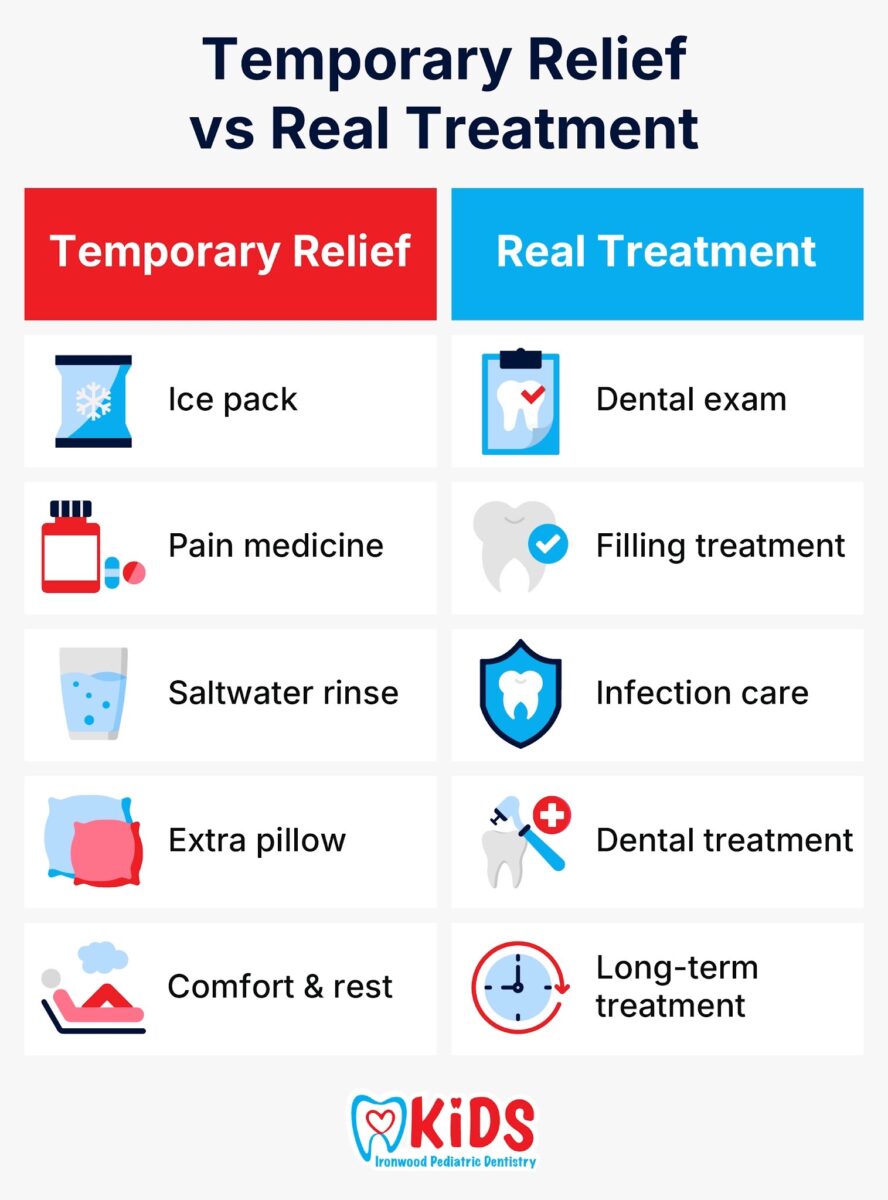
When your child wakes up with a toothache, you can take several steps to ease the pain until he or she can see a dentist. Some home remedies to try include:
- A cold compress. Place a cold pack or ice pack wrapped in a cloth on the outside of the cheek near the sore tooth. When you do this at short intervals of about 10 minutes, the cold will help numb the pain and reduce any swelling.
- Over-the-counter pain medications. If your child’s pediatrician or dentist approves, consider giving your child an age-appropriate dose of children’s acetaminophen (Tylenol) or children’s ibuprofen (Motrin or Advil) to reduce discomfort. Follow the dosing instructions on the package or your pediatrician’s guidance, based on your child’s age and weight (see the section below for important medications to avoid).
- Elevate your child’s head. Propping up your child’s head with an extra pillow at night can reduce blood pooling in the mouth and head. This can lessen a throbbing pain sensation at night.
- A saltwater rinse. If your child is old enough not to swallow it, you can have him or her gently rinse the mouth with a warm salt water solution of 1/2 teaspoon of salt in a cup of warm water. This can reduce inflammation, cleanse the sensitive area, and soothe gum pain around the affected tooth.
- Gentle oral hygiene. If you suspect that food is stuck, causing your child’s nighttime pain, you can help your child carefully brush and floss around the sore tooth to dislodge any food particles. Removing the source of pressure, like a popcorn hull or a piece of meat between teeth, can sometimes provide quick relief.
- Comfort and calm. Especially for younger children, provide plenty of comfort and reassurance at bedtime. Sometimes distractions like a favorite story or cuddling with a toy can help take your child’s mind off the pain enough to fall back asleep.
Note that these home care tips are temporary measures only and not substitutes for dental care. They do not cure the underlying problem, but can help manage pain until you can consult with a pediatric dentist.
Just as important as knowing what helps is knowing what to avoid. Some well-meaning home remedies can actually make your child’s tooth pain worse, delay proper treatment, or pose a serious safety risk.
What NOT to Do for Your Child’s Tooth Pain at Night
- Never give your child aspirin. Aspirin is linked to Reye’s syndrome, a rare but potentially life-threatening condition that causes swelling in the brain and liver in children and teenagers. Stick to children’s acetaminophen or ibuprofen at age-appropriate doses, and call your pediatrician with any dosing questions.
- Never place aspirin or numbing gel directly on the tooth or gums. Applying aspirin to the gums can chemically burn the soft tissue, and most adult topical numbing products are not safe for young children. If your child’s gums look raw or burned, contact your dentist promptly.
- Do not apply heat to your child’s cheek or jaw. Heat can increase blood flow and swelling in an already inflamed area, worsening the pain. Use a cold compress instead.
- Do not ignore tooth pain that returns night after night. Repeated nighttime tooth pain almost always indicates an underlying dental problem that will not resolve on its own. Call the dentist to schedule an exam, even if the pain eases by morning.
- Do not let your child eat hot foods or sweets before bed. Hot foods can trigger sensitivity in an inflamed tooth, and sugar feeds the bacteria that cause cavities. If your child needs a bedtime snack, offer soft, room-temperature foods instead.
When to Seek Immediate or Urgent Dental Care
In most cases, mild tooth pain can wait for a regular dental appointment. But in some situations, you should seek prompt medical or dental care, possibly even emergency care, instead of waiting. Here are some examples.
- Severe, unrelenting pain. If your child has intense tooth pain that does not improve with home care or pain medication, then you should consider it to be urgent in nature. Severe pain can indicate a serious issue, such as a deep infection that requires immediate attention.
- Facial swelling or gum swelling. Swelling of the gums, face, or jaw can signal a spreading dental infection or abscess.
- Fever or illness with a toothache. If a toothache is accompanied by fever, fatigue, or general illness, then an infection may be present. A fever suggests your child’s body is fighting something serious and needs prompt treatment like antibiotics or drainage of an abscess.
- Difficulty opening the mouth, swallowing, or breathing. These are serious symptoms that could indicate an infection has spread to the jaw or throat. If your child has any trouble breathing or swallowing, seek emergency medical care immediately.
- Recent injury to the mouth or jaw. If the tooth pain started after a trauma to the mouth, like a fall or a sports injury, and your child is experiencing pain or a tooth is cracked or loose, he or she may need urgent dental care to prevent complications or to save the tooth.
In any worrying situation at night, it is best to err on the side of caution. Contact your pediatric dentist’s emergency line or visit urgent care if you suspect a serious problem and your child can’t wait until morning.
The Importance of Seeing a Dentist Promptly
Nighttime tooth pain is usually a symptom of an underlying dental issue that will not get better on its own. As we mentioned above, home remedies can provide temporary pain relief but are not a long-term treatment.
So, even if your child’s toothache seems to get better in the morning, prompt evaluation by a pediatric dentist is crucial not only to provide pain relief but also to correct the causes of your child’s nighttime discomfort.
Nighttime tooth pain can lead to problems that go beyond oral health. A persistent lack of sleep can affect your child’s performance at school, and itself lead to other health issues. Prompt dental treatment helps protect baby teeth and permanent teeth while promoting good oral health and comfortable sleep at night.
Call Ironwood Pediatric Dentistry Today About Your Child’s Dental Pain at Night
The experienced Scottsdale pediatric dentists at Ironwood Pediatric Dentistry can identify the causes and effectively treat the symptoms of childhood nighttime oral pain. We can identify and treat the cause and help prevent possible complications that can turn a seemingly minor pain problem into a serious dental and overall health issue.
Call us at (480) 422-4544 to speak with an experienced child dentistry professional, or contact us online to get started relieving your child’s pain today.